Keeping a residence hall rug clean
Keep the care label and find the instructions for the actual rug. A routine for a shared room should fit the product, the building's rules and the people who use the room. This guide organizes care around one habit: read the manufacturer's instructions first, then decide, and never let a step in a checklist override what the label says.
Start with the label, not the stain
Every decision in this guide depends on one document: the care information for the actual rug in your room. That may be a sewn-in label, a hang tag, a product page or a leaflet. Keep it, or photograph it, on the day the rug arrives, because the label is easiest to find before it is cut off, lost or buried in the box.
If you cannot find it, the first job is to find it again: contact the seller, name the product exactly and ask for the care instructions in writing. Until you have them, treat every method in the rest of this guide as unconfirmed for your rug.
Plan routine care
The Carpet and Rug Institute recommends regular vacuuming, with the frequency adjusted to how much the rug is used.
Notice what the guidance leaves to you: how often. The Carpet and Rug Institute ties frequency to how much the rug is used, and this guide does not turn that into a schedule, because a rug beside a busy door and a rug under a bed are used differently. Decide the rhythm with your roommate, write it down, and adjust it if the rug looks or feels as though it needs more attention.
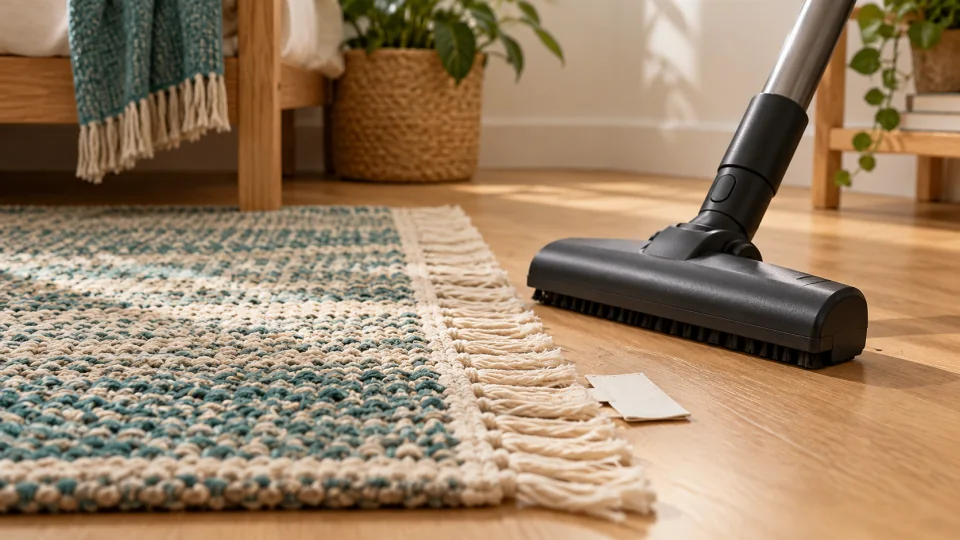
Shaw Floors, in its carpet care guidance, distinguishes long-pile styles from others. The lesson is simply that one vacuum setting is not right for every construction. Match the setting and attachment to your label, and if the label is silent about vacuuming, ask the seller before using a rotating brush.
- Choose a vacuum setting and attachment permitted for the rug's construction; Shaw Floors distinguishes long-pile styles from others in its care guidance.
- Keep fringes and loose yarn away from a rotating brush.
- Ask residence staff before using shared equipment or cleaning in a common area.
- Agree with your roommate who does the routine care and when.
A manufacturer-label-first routine card
A routine is easier to keep when it is written down once and shared. The card below is a suggested structure; every entry is filled in from the label, not from this page.
Keep the card with your move-in paperwork. At move-out the same card tells you what the rug needs before it is packed, which is when the Move-in and move-out checklist becomes useful.
- Product and source: the product name, where the care information came from and the date you read it.
- Vacuuming: the permitted setting and attachment, and whether a rotating brush is allowed. If the label is silent, write 'ask seller' and do not guess.
- Frequency: the rhythm you and your roommate have agreed, noted as your own arrangement and not as a standard.
- Who and when: the person responsible and the agreed time, so the task does not depend on memory.
- Spot treatment: the methods the label permits, in its words, and any it excludes.
- Washing: whether whole-rug machine washing is permitted, the drying method, and any limits on size or weight.
- Housing limits: which cleaning products may be kept and used in rooms, and whether shared equipment may be used, as stated by your residence staff.
- Moisture contact: who to tell, and how, if a damp patch or musty smell appears.
Respond to a spill without escalating
Blot liquid with a clean white cloth instead of rubbing, then use only a method permitted for that rug.
Do not add water, a powder or a solvent simply because a mark remains. Follow the approved product's directions and stop if the color or texture changes.
An ordinary drink-spill decision checklist
The checklist below puts the source guidance in a sequence you can follow quickly. It is a decision aid, not a cleaning recipe: at each step the answer comes from the rug's own instructions. It contains no quantities, products or solvents, on purpose.
- For an ordinary drink spill, blot the liquid with a clean white cloth instead of rubbing.
- Do you have the care instructions for this rug to hand? If not, stop at blotting and get them from the seller before doing anything else.
- Do the instructions name a method for this kind of mark? If yes, use only that method and follow its directions. If they name an approved product, read the product's own label too.
- Do the instructions say nothing about this kind of mark? Contact the seller or manufacturer with the exact product name and a description of the mark. Do not substitute a method from another rug, another fiber or another website.
- Does a mark remain after the permitted method? That alone is not a reason to add water, a powder or a solvent. Go back to the instructions or ask the seller.
- Did the color or texture change at any point? Stop, do not continue with the same method, and contact the seller or manufacturer.
- Is the area still wet, or does it smell damp or musty later? Do not put the rug back on the floor or pack it away damp, and go to the moisture section below. If the water came from a leak, report the leak.
- Will you use a cleaning product that the instructions allow? Follow the directions on its label, make sure the space is well ventilated, never mix products, and check your residence rules on which cleaning products may be kept and used in rooms.
What the checklist does not cover
This checklist covers ordinary drink spills and does not specify methods for solid residue, unknown substances or contamination requiring special handling. Consult the actual rug's care instructions and obtain appropriate advice for those situations. This is routine floor-covering care, not a health procedure.
Using cleaning products safely
If the rug's care instructions allow a cleaning product, the CDC's household cleaning guidance applies: follow the directions on the product label, make sure the space is well ventilated, and never mix products, in particular bleach with ammonia or any other cleaner.
Check your residence rules on which cleaning products may be kept and used in rooms.
The order matters. The rug's instructions decide whether a product may be used at all; the product's label decides how; the building's rules decide whether the product may be in your room in the first place. A product that satisfies only one or two of those three is not ready to use.
Whole-rug washing
Wash a rug in a machine only if the label permits it and the laundry operator accepts its size and weight. Dry it by the specified method.
A small or synthetic rug is not automatically washable, and a natural-fiber label is not a complete cleaning instruction. A label that only names a natural fiber tells you what the rug is made of, not how to clean it.
Washing a whole rug needs three yeses before you start: the label says the item may be machine washed, the drying method is stated, and whoever runs the laundry confirms that a rug of that size and weight is accepted. If any one is a no or a don't-know, the answer for now is no.
Drying, moisture and storage
Do not put a wet rug back on the floor or pack it away damp. Follow the supplier's storage instructions.
The EPA's guidance states that the key to mold control is moisture control, and its material on finding mold and moisture includes carpet backing among the places to check. A persistent damp patch or musty smell warrants investigation and a report to residence staff, not a deodorizing powder. If the water comes from a leak, report the leak instead of treating the rug alone.
This page does not recommend baking soda as universally safe for rugs or vacuums.
A practical way to apply this is to split moisture into two cases. In the first, the rug got wet through a spill and the permitted method has been followed: the next question is how it will be dried, and the answer is on the label. In the second, the damp has no obvious cause or keeps returning: the rug is no longer the main subject, and the report to residence staff is.
Storage follows the same principle. Before the rug is packed away for a break or for move-out, check that it is dry by the method the supplier specifies, and keep the supplier's storage instructions with the care card.
Two hypothetical situations
These cases are invented to show the checklist in use; the rugs, labels and events are hypothetical.
Case one. A drink is knocked over onto a rug. The owner blots it with a clean white cloth and checks the care card, which names a permitted spot method. The owner follows that method, and a faint mark remains. The checklist says not to reach for more water, a powder or a solvent. Instead the owner returns to the instructions and, finding nothing further, writes to the seller.
Case two. A rug has a musty smell near one edge that returns after drying. The care card says nothing about that. Moisture guidance includes carpet backing among the places to check and treats the cause of the damp as the real question, so the owner reports it to residence staff instead of reaching for a deodorizing powder, and mentions any suspected leak.
Next steps
Coordinate the routine with the move-out steps in the checklist, and compare the care questions for different materials. The Move-in and move-out checklist covers the move-out side, and Choosing a rug material for a residence hall room sets out the label questions for different materials. General questions are on the Frequently asked questions page.
Sources and scope
These references support general guidance. Follow the instructions for your actual product and, where relevant, your own building or housing policy.
The Carpet and Rug Institute, Shaw Floors, EPA and CDC pages support the general points attributed to each above; none is a statement about your particular rug. The archived capture of the earlier site is cited only for the historical subject scope of this domain, not for current prices, facilities, health advice, product performance or affiliation. This is an independent editorial resource and not a former operator.
Frequently asked questions
How often should I vacuum a residence hall rug?
The Carpet and Rug Institute recommends regular vacuuming, with the frequency adjusted to how much the rug is used. This guide does not set a schedule. Agree a rhythm with your roommate, write it on your care card, and check the label for the vacuum setting and attachment permitted for the rug's construction.
What should I do first when something is spilled on my rug?
For an ordinary drink spill, blot the liquid with a clean white cloth instead of rubbing, then use only a method permitted for that rug. Do not add water, a powder or a solvent simply because a mark remains, and stop if the color or texture changes.
Can I put baking soda on a rug or in a vacuum?
This guide does not recommend baking soda as universally safe for rugs or vacuums, and it gives no powder or solvent recipe. Use only a method permitted by the rug manufacturer and the product label; a seller's suggestion does not replace those instructions. A damp patch or musty smell calls for investigation and a report to residence staff, not a deodorizing powder.
Can I wash the whole rug in a machine?
Only if the label permits it, the laundry operator accepts its size and weight, and you dry it by the specified method. A small or synthetic rug is not automatically washable, and a label that only names a natural fiber is not a complete cleaning instruction.
Sources
- https://carpet-rug.org/carpet-for-homes/cleaning-and-maintenance/
- https://shawfloors.com/en-us/care-and-warranties/carpet
- https://www.epa.gov/mold/mold-course-chapter-3
- https://www.epa.gov/mold/brief-guide-mold-moisture-and-your-home
- https://www.cdc.gov/hygiene/about/when-and-how-to-clean-and-disinfect-your-home.html
- https://web.archive.org/web/20120518025229/http://www.rhcarpets.com:80/