Comparing example rug sizes, with exact metric equivalents
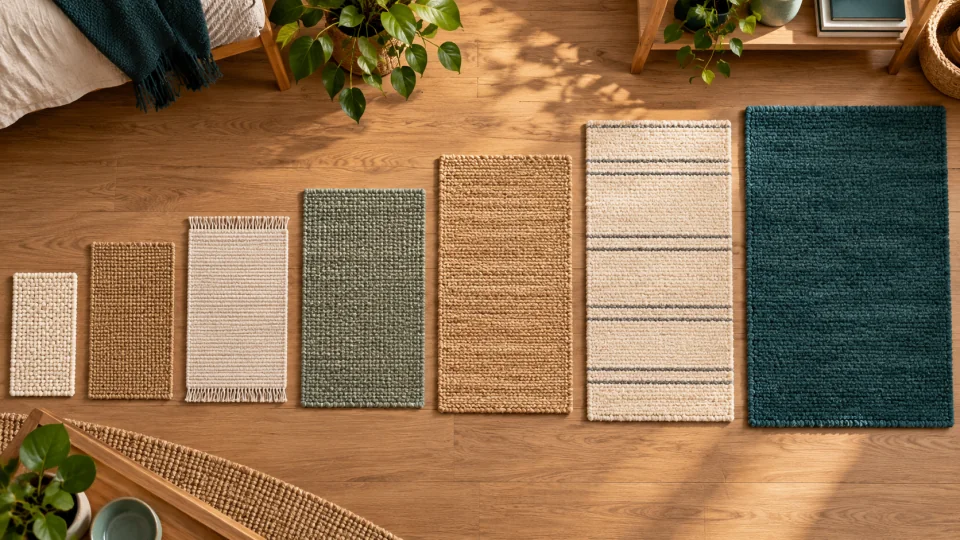
Compare seven nominal rug sizes and their exact metric equivalents, then work through an invented 12 × 15 ft floor. The examples are measuring-calculator candidates, not popularity rankings, actual products or recommendations for a particular room.
How the conversions work
Sizes are given in feet (ft) with metric equivalents. One international foot is exactly 0.3048 meters, as NIST confirms, so one foot is exactly 30.48 centimeters and one square foot is exactly 0.09290304 square meters. The centimeter figures below are exact; the square-meter figures are rounded to two decimal places.
Multiply feet by 30.48 for centimeters and square feet by 0.09290304 for square meters. The latter factor is 0.3048 × 0.3048. For example, 182.88 × 274.32 cm = 50,167.6416 cm² = 5.01676416 m², rounded to 5.02 m² for the 6 × 9 ft row.
Nominal means the labeled size. Check the actual product dimensions; no manufacturing tolerance or real campus-room measurement is asserted.
Seven example sizes
Each entry gives the nominal size, its exact metric equivalent, the floor area and one point to check before using that size.
- 2 × 3 ft: 60.96 × 91.44 cm; 6 sq ft, about 0.56 m². Check that it does not create a loose edge where you plan to put it.
- 3 × 5 ft: 91.44 × 152.4 cm; 15 sq ft, about 1.39 m². Measure the whole of the intended location.
- 4 × 6 ft: 121.92 × 182.88 cm; 24 sq ft, about 2.23 m². Confirm the clear floor area instead of relying on the room type.
- 5 × 7 ft: 152.4 × 213.36 cm; 35 sq ft, about 3.25 m². Compare it with the actual rectangle available.
- 5 × 8 ft: 152.4 × 243.84 cm; 40 sq ft, about 3.72 m². Check both orientations against obstructions.
- 6 × 9 ft: 182.88 × 274.32 cm; 54 sq ft, about 5.02 m². Check door and furniture clearance separately.
- 8 × 10 ft: 243.84 × 304.8 cm; 80 sq ft, about 7.43 m². Do not infer suitability from a label such as suite or bedroom.
Reading the seven rows side by side
The list is a ladder of floor areas with uneven rungs. Moving down it adds 9 sq ft (2 × 3 to 3 × 5), another 9 sq ft (to 4 × 6), 11 sq ft (to 5 × 7), only 5 sq ft (to 5 × 8), 14 sq ft (to 6 × 9) and 26 sq ft (to 8 × 10). The smallest step is 5 × 7 to 5 × 8: both are 152.4 cm wide and the second is 30.48 cm longer. The largest is 6 × 9 to 8 × 10, which adds 60.96 cm of width and 30.48 cm of length.
Rounding matters when you subtract. The square-meter figures are rounded, so 7.43 − 5.02 gives 2.41 m², yet the exact difference of 26 sq ft is 2.41547904 m², which rounds to 2.42 m². Do arithmetic on the exact feet or centimeter figures and round only the answer you display.
These increasing areas do not rank popularity or suitability. Use your own measured space and product dimensions.
Worked example: a 12 × 15 ft floor
Imagine 12 × 15 ft of open floor. A 6 × 9 ft rug placed in the center leaves 3 ft of bare floor on every side. A 5 × 8 ft rug in the same position leaves 3.5 ft on every side. This is an arithmetic example, not a recommended layout.
The fictional floor is 365.76 × 457.2 cm, or 180 sq ft (about 16.72 m²). Centering splits the difference equally: (12 − 6)/2 and (15 − 9)/2 are both 3 ft, or 91.44 cm; (12 − 5)/2 and (15 − 8)/2 are both 3.5 ft, or 106.68 cm.
The covered and bare areas follow from the same rows in the list above. The bare-floor square-meter values below are calculated from exact square feet and then rounded, so subtracting already rounded display values can give a different last decimal:
- 6 × 9 ft rug: 54 of the 180 sq ft is covered (30%), leaving 126 sq ft of bare floor, about 11.71 m².
- 5 × 8 ft rug: 40 of the 180 sq ft is covered (about 22%), leaving 140 sq ft of bare floor, about 13.01 m².
- Difference between the two: 14 sq ft, about 1.30 m², and 0.5 ft (15.24 cm) on every side.
The borders are equal on all four sides only because this example is an empty, perfect rectangle with the rug centered. A real room has a door, perhaps heaters and vents, and furniture, none of which appear in the arithmetic. The 3 ft and 3.5 ft borders are not safety allowances, campus measurements or product tolerances.
Moving the rug: position and orientation
On that fictional floor, sliding changes how the leftover space is shared; turning changes the leftover on each axis. These are calculations, not layout recommendations.
After a quarter turn, the 6 × 9 ft rug leaves 1.5 ft on two sides despite covering the same area. Check orientation against doors and obstructions separately.
- 6 × 9 ft, centered: 3 ft (91.44 cm) of bare floor on each of the four sides.
- 6 × 9 ft, slid 2 ft toward one of the two 15 ft walls: 1 ft (30.48 cm) on that side and 5 ft (152.4 cm) on the other; the pair still adds up to the 6 ft left over across the 12 ft width.
- 6 × 9 ft, turned a quarter turn so the 9 ft side runs across the 12 ft width: 1.5 ft (45.72 cm) on each side across the width and 4.5 ft (137.16 cm) at each end.
- 5 × 8 ft, turned the same way: 2 ft (60.96 cm) on each side across the width and 5 ft (152.4 cm) at each end.
Products sized in centimeters
A rug labeled in centimeters may not match any of these examples exactly. Compare its stated dimensions with your measurements instead of matching it to a familiar size name. Convert in one direction only, using the exact factor, so that rounding errors do not build up.
An invented 150 × 240 cm label is 2.4 cm narrower and 3.84 cm shorter than 5 × 8 ft (152.4 × 243.84 cm). On the converted 365.76 × 457.2 cm floor, centering leaves (365.76 − 150)/2 = 107.88 cm across and (457.2 − 240)/2 = 108.6 cm along. Similar is not equal.
Early rounding introduces differences: 150 cm = 4.921259… ft, while 4.9 ft converts back to 149.352 cm, about 0.65 cm less. Likewise, 240 cm = 7.874015… ft, but 7.9 ft converts to 240.792 cm. Convert once and round only for display.
Rules of thumb, with their limits
These points help with the comparison, but none of them is a safety standard.
- Choose a border for your own layout, then check door operation, equipment clearances and the applicable housing rules separately. No universal one-foot safety allowance is claimed here.
- Check whether any furniture placement is permitted and stable; visual preference alone does not make an arrangement safe.
- Compare both orientations with the available space, the doors and any obstructions.
- For an unusually shaped space, compare the actual dimensions of alternative products instead of assuming that a particular shape or width is best.
- Check the care and handling instructions for the particular product; a small rug is not necessarily washable.
A worksheet for comparing sizes
Use this suggested worksheet to attach calculations to the real room. For the measuring method, see the measuring guide.
- Write down the open floor rectangle you measured in feet and in centimeters, converting once with 30.48 and keeping the unrounded figures.
- List what interrupts that rectangle: the door and its swing, heaters, floor vents, and any furniture that is permitted to stay where it is.
- For each candidate size, write its dimensions in both orientations and calculate the room minus the rug on each axis.
- Where the leftover is shared unequally, check that placement separately against the door swing and the obstructions.
- Check the housing rules, the product's own handling and care instructions, and whether a pad is permitted, before treating any size as a real candidate.
- Record the decision with the date and the measurements somewhere your roommate can see; the shared layout guide covers that conversation.
Next steps
The measuring calculator checks each of these sizes against your own measurements; start at measuring your room. To compare materials, see the rug material questions. When you have a candidate size, review door, edge, cord, heater and chair checks in planning a safe, shared layout.
Sources and scope
These references support general guidance. Follow the instructions for your actual product and, where relevant, your own building or housing policy.
NIST supports the unit factor; the housing reference is one example of building rules. Neither endorses a rug size. Archive references establish historical topic scope, not current products, prices or affiliation. This is an independent editorial resource.
Frequently asked questions
Are the centimeter figures on this page exact or rounded?
The seven rows’ centimeter figures are exact multiples of 30.48. Their square-meter figures are rounded to two decimals from 0.09290304 m² per square foot. Use unrounded dimensions or areas in calculations and round the final displayed answer.
Does a 3 ft or 3.5 ft border mean the layout is safe or allowed?
No. On the invented floor, those borders are arithmetic, not safety allowances. Check the actual door, equipment, furniture, product instructions and housing rules separately. If someone uses a mobility aid, involve them and the appropriate housing or accessibility office.
On a 12 × 15 ft floor, should I choose a 6 × 9 ft or a 5 × 8 ft rug?
Neither is recommended here. Centered in the imaginary floor, 6 × 9 ft covers 54 sq ft with 3 ft borders, while 5 × 8 ft covers 40 sq ft with 3.5 ft borders. A real room has obstructions: measure, compare orientations and check product and housing requirements.
What if a rug is labeled in centimeters and matches none of the seven sizes?
Compare its stated dimensions directly with your measurements instead of rounding it to the nearest familiar name. Convert your room once, using 30.48 cm per foot, and work in centimeters from there. Check the actual measurements of the product as well, since no manufacturing tolerance is asserted on this page.