Choosing a rug material for a residence hall room
A fiber name is only one part of a rug's specification. Construction, backing, finish and the manufacturer's care instructions all affect how a rug can be used and looked after. Do not infer fire approval, washability or floor compatibility from the fiber alone. This guide turns that idea into a label comparison worksheet you can fill in for each rug you are considering, so that two products are compared on the same questions instead of on a single word such as wool or polyester.
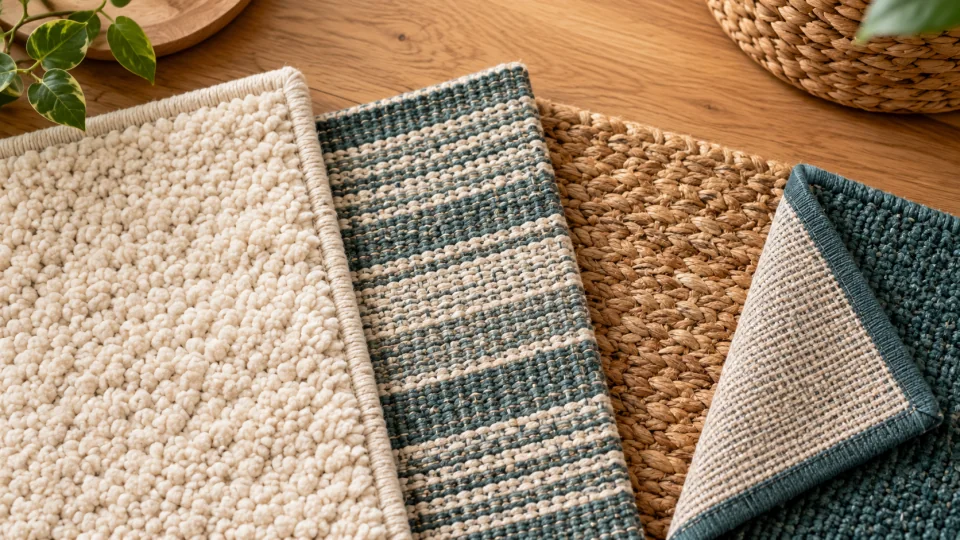
Read the whole label
Before comparing fibers, find out what the product information actually covers. If any of the points below is missing, ask the seller before you buy instead of assuming.
The five points interact: a fiber that looks straightforward may sit alongside a backing note that rules out your floor, or a care line that excludes the method you were counting on. Treat each line as a question the seller has either answered or not answered, and treat an unanswered line as information: the decision is not yet ready.
- Fiber content: which fibers are named, and in what proportion if the rug is a blend.
- Construction: for example tufted, woven, braided or flatweave, and whether the pile is long or short.
- Backing: what is on the underside, and what the supplier says about the floor types it may be used on.
- Care: which vacuum settings, spot treatments and washing methods are permitted, and which are excluded.
- Dimensions: the actual stated size, not just a size name.
A product-label comparison worksheet
The worksheet below is a suggested way to organize what you find, not a standard and not something any housing office has asked for. Make one copy per rug, using a notes app, a printed page or the margin of a shopping list. Fill in only what the product information actually says, and write 'not stated' where it is silent. Do not fill a gap from memory about what a fiber is usually like.
Notice what the worksheet leaves out. There is no score, no total and no row for a preferred fiber. A tally would imply equal weight for every row and a ranking the sources do not support. The worksheet only shows, side by side, which questions each product has answered and which it has left open.
- Row 1, identity: the product name or code exactly as the seller lists it, the seller's name, and the date you read the information. Product pages can change, so the date matters if you later need to show what you relied on.
- Row 2, fiber: every fiber named, with any proportions. If the label gives only a single word for a blend, record that and ask for the breakdown.
- Row 3, construction: tufted, woven, braided, flatweave or another term, plus whether the pile is long or short. Copy the seller's own words rather than translating them.
- Row 4, backing: what is on the underside and which floor types the supplier says it may be used on. Note separately whether a pad is mentioned, recommended or excluded.
- Row 5, care: the permitted vacuum settings, spot treatments and washing methods, and anything the label excludes. If the item is described as machine-washable, record the drying method stated next to that claim.
- Row 6, dimensions: the actual stated size and the unit it is stated in, and whether it is a size name or a measured figure.
- Row 7, housing questions: anything your housing office has asked you to supply about floor coverings, and whether the supplier can provide it. Record what the housing office says it accepts, in its words.
- Row 8, open questions: everything marked 'not stated', with the date you asked and the answer you received.
Questions to compare by material
These are checks to make for a particular product, not a ranking of fiber performance.
Read the prompts below as feeding the care row of the worksheet. With a synthetic fiber such as polypropylene, polyester or nylon, the open questions are the product's own permitted methods and whether the backing suits the floor; the fiber name answers neither. With wool, the question is which cleaning products and methods the manufacturer permits, and the WoolSafe testing page is useful background on how products are assessed for compatibility with wool floor coverings. Treat it as background rather than as a statement that any particular rug or cleaner suits your room.
For cotton and flatweave items the key word is explicit: an item is machine-washable if its own product information says so and gives a drying method, not because it is small or flat. For jute, sisal and other plant fibers, ask what the supplier says about spills and moisture, and be wary of any generic water-based recipe, including one copied from elsewhere.
- Polypropylene, polyester or nylon: what cleaning and vacuum methods does this product permit, and does its backing suit your floor?
- Wool or a wool blend: which wool-suitable cleaning products and methods does the manufacturer permit? WoolSafe explains how it tests products for compatibility with wool floor coverings.
- Cotton or a flatweave: is this particular item explicitly machine-washable, and what drying method is specified?
- Jute, sisal or another plant fiber: what does the supplier say about spills and moisture? Do not rely on a generic water-cleaning recipe.
Two hypothetical labels, compared
The following case is invented to show how the worksheet is used. The products, wording and sizes are hypothetical, they do not describe any real rug or seller, and nothing in them is a measured result.
Suppose Rug A's page names its fiber content and construction but says nothing about backing, pad use or washing. Suppose Rug B's page lists all of those, but its care line says spot treatment only and excludes machine washing.
On the backing and care rows, Rug A needs answers, including the pad question. Rug B gives explicit answers on those points, including its restriction to spot treatment. That does not make Rug B the better rug, and neither record establishes dimensions or housing approval. Compare the stated restrictions with your intended use while asking for the missing information. If you share a room with someone who expects to throw the rug in a laundry machine at the end of term, Rug B's care line is a real obstacle, and you would want to know that before purchase rather than after.
Check construction against the room
Measure the actual door clearance and consider the edges, pile height and backing together. A rug that seems comfortable in a shop may catch under a door that has to open over it.
Ask whether the housing rules allow the proposed covering and any pad. A separate pad is not automatically compatible with every floor finish and is no guarantee against marks.
Taking the worksheet into the room
In practice this means taking three pieces of information from the worksheet into the room: the construction and pile description, the backing line and the stated dimensions. Open the door through its full swing and look at the gap between the door's lower edge and the floor, then imagine the rug and any pad stacked in that space. If the seller has not stated the thickness of the rug at its edge, record that as an open question; a figure for it is not something to estimate from a photograph. Where the housing rules are unclear, put the question to the housing office in writing, name the rug and pad you are considering, and keep the reply with your worksheet.
Keep care and safety separate
Cleaning instructions say nothing about whether a rug meets a residence hall's fire rules. If your building asks for product information, obtain it from the supplier and check with the housing office what it accepts.
For a delicate or heirloom rug, the Carpet and Rug Institute advises manufacturer-specific instructions or appropriate professional care. Consider whether a shared room is the right place for it.
Keeping these two threads apart avoids a common muddle. A care line answers 'how do I look after this?' Applicable fire requirements answer a different question: ask the housing office which requirements apply and what product information it accepts. They cannot be inferred from a fiber name or decided by this site. This guide does not say which rugs a residence hall accepts, and nothing here should be read as saying that a rug passes any fire requirement. The worksheet's housing row exists so that the answer comes from the people entitled to give it.
Choosing between candidates without a ranking
Once two or three worksheets are filled in, resist the urge to add them up. A more useful approach is to sort the decision into three questions, in this order.
- Which products are complete enough to judge? Set aside any worksheet with unanswered backing, care or housing rows until the seller replies.
- Which complete products are permitted? Check backing and pad statements against your floor and the housing rules. Remove any product whose care or backing line conflicts with how the room will be used.
- Of what remains, which fits the people and the room? Compare the stated size with your measurements, the pile and edge with your door, and the care method with who will actually do the cleaning.
Next steps
Compare example dimensions, room layout checks and care planning in the related guides. Comparing example rug sizes is the place for example sizes, Measuring your room and finding a rug size that fits explains the size calculator, Planning a safe, shared layout is for layout checks, and Keeping a residence hall rug clean is for upkeep. General questions are on the Frequently asked questions page.
Notice that material appears in none of the three questions above as a rank. It appears as a source of questions. Someone who wants easy machine washing will find that answered by the label of a particular item, not by a fiber category; someone who prefers to vacuum and spot-treat will ask a different set of care questions. Both can use the same worksheet.
Sources and scope
These references support general guidance. Follow the instructions for your actual product and, where relevant, your own building or housing policy.
The WoolSafe and Carpet and Rug Institute pages support the general points attributed to them above; the housing page is listed as a housing-office reference and is not relied on here for any specific rule. The archived capture of the earlier site is cited only for the historical subject scope of this domain, not for current prices, facilities, health advice, product performance or affiliation. This is an independent editorial resource and not a former operator.
Frequently asked questions
Which rug fiber is best for a residence hall room?
This guide does not rank fibers, because the sources behind it do not support a ranking, and the same fiber name can appear in products with different constructions, backings and care instructions. Compare particular products on the worksheet instead: fiber content, construction, backing, permitted care and stated size. Then check those answers against your floor, your door and your housing rules.
Does a care label show that a rug meets residence hall fire rules?
No. Cleaning instructions and fire rules answer different questions, and neither can be inferred from the fiber alone. If your building asks for product information, request it from the supplier and ask the housing office what it accepts. This guide does not state what any residence hall requires or approves.
Can I use any pad under a rug?
Not automatically. A separate pad is not guaranteed to be compatible with every floor finish and gives no guarantee against marks. Ask the housing office whether the rug and any pad are allowed, and record what the rug's backing information says about the floors it suits.
Is a cotton or flatweave rug machine-washable?
Only if the information for that particular item says so. The label should state the washing method and the drying method; if it does not, ask the seller. For shared laundry, also check the operator's rules and the machine manufacturer's capacity and instructions before planning to use it.