Planning a safe, shared rug layout in a residence hall room
A rug changes movement through a shared room, including visibility in low light. Discuss the layout before use and record checks, decisions and unknowns with your roommate. Completing the sheet does not make a layout safe or approved.
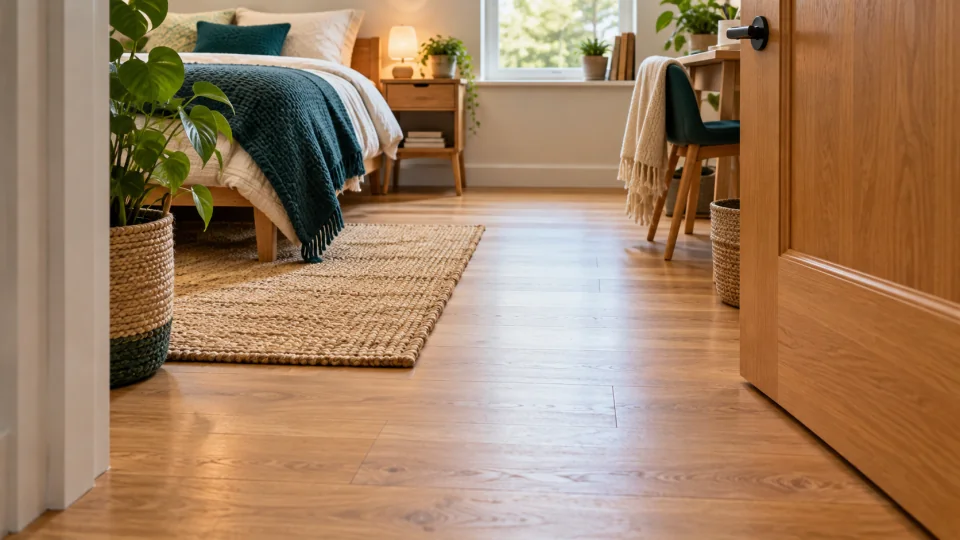
Check the rules for your building
Use the floor-covering and electrical rules for your own building; the university handbook cited here is one example. Read the current handbook or ask residence staff before you lay anything down. This guide cannot tell you what your building allows.
Permission for one item does not confirm the whole layout. Treat missing answers as open questions.
Three permission questions to ask separately
Ask separately about the rug, anything beneath it and nearby equipment. A yes to one does not answer the others. Record each answer.
If an answer is unknown, mark it unknown and hold off on the related step instead of reading silence as permission. Residence staff and the product's supplier are the people who can answer; this site cannot.
- The floor covering: is a rug allowed on this floor and in this room, and does the product's own care and handling guidance suit it?
- What goes under or on it: confirm pad compatibility with the rug and floor and permission under the housing rules. Use adhesive only where both the floor instructions and housing rules permit it. If a needed pad or fixing remains unconfirmed, postpone using that arrangement.
- What is near it: which electrical equipment and heaters may be used, how cords must be arranged, and what must stay uncovered, such as radiators, baseboard heaters and floor vents.
Keep the exit clear
The door must open fully without catching on the rug or pushing it into a fold. If the rug obstructs the door, change or remove it; a fiber or weave label alone does not establish clearance.
Never let a rug, a pad or anything placed on them narrow the route to the door.
Suggested prompts for checking the door and its route
These are prompts for inspecting a possible layout, not a clearance test or safety certification. Stop if an obstruction appears; no regulatory distance is supplied.
- Lay the rug in the exact position you intend to use, with any approved pad, and close the door.
- Check the door’s movement slowly, without forcing it against the rug or pad. Stop if it catches, lifts or folds an edge.
- Look for catching, lifting, rippling or folding, and for the rug shifting after the door passes over or near it.
- Check that nothing placed on the rug, such as a bag, a box or a shoe rack, narrows the route from the door into the room.
- Inspect routes from each bed to the door with adequate light and remove obstructions before use. Consider how reduced light affects visibility; do not deliberately walk an unresolved route in the dark.
- If any step fails, change the position or remove the rug, then repeat from the first step.
Prevent trips
Check edges, pads and fixings deliberately before using the layout.
In a fictional example, a corner curls into the bed-to-door route. Remove it from use while asking the supplier how to handle it, or remove the rug. Do not assume that one-day reverse rolling suits its backing.
- Use only a pad approved for the rug, the floor and the applicable housing rules.
- Do not leave a curled edge in a walking route; ask the supplier how to deal with it, or remove the rug. A one-day reverse-rolling method is not suitable for every backing.
- Use no adhesive unless both the floor supplier's instructions and your housing rules permit it.
If someone uses a mobility aid
If someone uses a mobility aid, review the actual layout and any floor covering with them and the appropriate housing or accessibility office; this guide does not specify accessibility clearances, widths or transitions.
Record who was consulted and the remaining questions. Involve the person before purchase where possible; a completed sheet cannot replace that consultation.
Cords, heat and vents
Never run extension cords, power strips or chargers under a rug. Heat can build up out of sight, and damage to a cord can go unnoticed.
A rug layout is not permission for a cord arrangement; follow the building rules and the equipment instructions.
Keep rugs back from radiators, baseboard heaters and any heater your building permits, and do not cover floor vents. This page gives no distance for that, because the right answer depends on the heater's instructions and the building's rules.
Fictional example: a lamp’s convenient outlet is across the rug. Do not hide the cord beneath it. Ask residence staff about permitted arrangements and reconsider the rug or desk position instead of assuming convenience is permission.
Furniture and chairs
Check chair movement for stability, obstructions and compatibility with the floor and the rug. A chair that catches on a rug edge can drag the rug out of position.
Fictional example: a rolling chair meets a rug edge. Inspect its ordinary movement carefully; do not push back or stand abruptly to provoke a catch. If it catches or shifts the rug, stop using that arrangement and change the layout in line with the product and housing instructions.
Do not change bed supports or ladders. Before placing a rug under either, check the authorized arrangement with the housing office and furniture manufacturer instructions.
A review sheet for roommates
Fill in the sheet together. Use checked for this arrangement, change needed, not applicable or unknown. Unknown remains an open task; none of these labels certifies safety.
- Header: building, room, date, and the names of everyone who shares the room.
- Rug: label or product name, stated dimensions, where the care label or packaging is kept, and who owns it.
- Rule sources: for floor covering, pad or adhesive, and electrical equipment and heaters, write the document or the person asked, the date, and the answer (allowed, not allowed, unknown).
- Door: does it open fully without catching, lifting or folding the rug? Is the route into the room unnarrowed?
- Walking routes: unobstructed from each bed and desk to the door; consider visibility in usual low light without walking through unresolved hazards.
- Edges and corners: any curl, lift or loose area in a walking route; what was done about it.
- Pad or fixing: none, or approved for the rug, the floor and the housing rules; who confirmed it.
- Cords and chargers: confirm that none runs under the rug; note the arrangement and the rule it follows.
- Heaters, radiators and vents: marked on a sketch and uncovered; instructions and building rules consulted.
- Chairs: ordinary movement inspected carefully; any catching or rug movement resolved before use.
- Beds and ladders: unaltered and arranged as authorized.
- Mobility aid: who is affected, who was consulted (including the housing or accessibility office), and the date.
- Decisions: who owns the rug, who looks after it, what happens at move-out.
- Initials and date from each roommate, plus a list of unknowns that still need answers.
A hypothetical completed review
This invented record concerns Roommates A and B, not an actual room or completed inspection.
Pad permission is unclear, so A records a question for residence staff. They do not treat an unpadded rug as automatically suitable or the layout as ready for use. During the door inspection an edge catches; they move the rug and recheck carefully. B records the unresolved lamp-cord arrangement and leaves the lamp disconnected rather than running a cord beneath the rug.
The chair catches a corner during careful ordinary movement, so they stop using that position and move the rug out of its travel. Neither uses a mobility aid; they note that a visitor or new roommate may require another review. A owns the rug and B coordinates care; both initial the record.
Pad permission and the cord arrangement remain open, with A and B responsible respectively. The sheet is unfinished, not a release or approval.
Agree on it with your roommate
Decide together where the rug goes, who owns it, who looks after it and what happens to it at move-out. Note your decisions on the move-in checklist, and read the cleaning guide to share the upkeep.
If the space differs from expectations, measure again. See sizes, measuring and material questions for the separate decisions.
When to repeat the review
A layout that was reviewed once is only reviewed for the room as it was that day. Consider repeating the sheet whenever something changes:
- new or rearranged furniture, including chairs, desks and bed arrangements;
- new electrical equipment or a different outlet in use;
- a heater being added, moved or changed, where the building permits one;
- a rug that has been rolled, cleaned, moved or re-laid;
- a new roommate or a regular visitor, particularly if they use a mobility aid;
- an update to the building's rules, or an answer arriving for an item marked unknown.
Sources and scope
These references support general guidance. Follow the instructions for your actual product and, where relevant, your own building or housing policy.
The university page is one example of housing rules. The archive establishes historical topic scope only, not current rules or affiliation. This independent editorial site does not approve a layout.
Frequently asked questions
Can I run a charger cord under a rug if it lies flat?
Do not run extension cords, power strips or chargers under a rug: hidden heat and damage are concerns. A flat cord does not change that guidance. Follow the building and equipment instructions and ask residence staff about permitted arrangements.
What counts as a rug that obstructs the door?
The door must open fully without catching on the rug or pushing it into a fold. If the rug obstructs the door, change or remove it. A fiber or weave label does not establish clearance, and this page gives no distance, so use the suggested door and route prompts to look at your actual door and rug together.
What if my roommate and I disagree about where the rug goes?
Separate the disagreement into specific checks. Record ownership, care and move-out decisions. Ask residence staff about unclear rules and measure again where space is disputed; an unknown is a question to resolve, not an argument to win.
Does completing the review sheet mean my layout is safe or approved?
No. The sheet records checks and conversations, not safety approval. It replaces neither current building rules nor product and equipment instructions. Involve the housing or accessibility office where needed for a mobility-aid user. This guide gives no regulatory clearance dimensions.